
When you walk into a UK university CAS interview, the assessor isn't just listening to your words — they're observing your body language, assessing your factual accuracy, judging how well you've researched your course, evaluating how clearly you express yourself, and deciding whether you come across as a genuine, confident applicant. CasApp.ai's 5C model is built to mirror exactly that multi-dimensional assessment — powered by AI.
Why a Single Score Isn't Enough
Traditional interview prep gives you feedback like "good answer" or "needs improvement." But a CAS interview assessor is making several distinct judgements simultaneously. A student might give a factually perfect answer but deliver it so nervously that the assessor loses confidence. Another might be relaxed and articulate but miss key course-specific details entirely.
That's why we designed the 5C model — five independent dimensions that together paint a complete picture of interview readiness, just like a real examiner would.
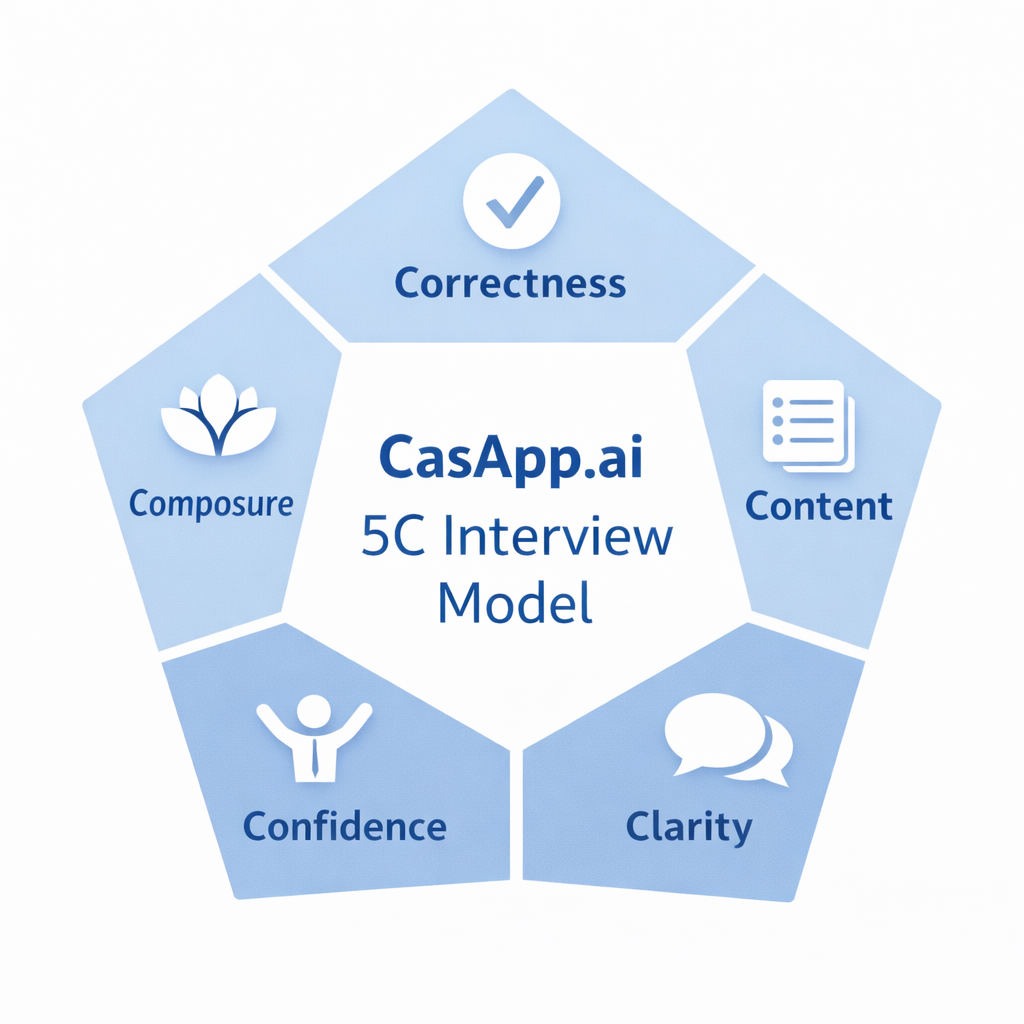
How Each Dimension Is Scored
1. Correctness — Are the Facts Right?
This dimension evaluates whether your answer is factually accurate and directly addresses the question asked. An off-topic answer — no matter how eloquent — scores low on Correctness. A short, precise, factually sound answer scores high.
For financial questions, our AI is calibrated to the current UK Home Office living cost requirements (updated as regulations change), so it knows whether you're citing the right figures. For university-specific questions, it evaluates whether your details are plausible and coherent with your stated institution and course.
2. Content — How Deep Is Your Preparation?
Content scores the richness and depth of your answer. Did you mention specific course modules? Did you demonstrate genuine knowledge of your chosen university? Did you articulate a realistic financial plan or accommodation arrangement?
A student who says "I want to study Business" scores lower than one who says "I'm drawn to the Strategic Management module in Year 2 of the BA Business Management course, particularly because it aligns with my three years working in my family's import business in Lagos." Content is where preparation shows.
3. Clarity — Can You Be Understood?
CAS interviews are conducted in English. Clarity measures how clearly, coherently, and logically you express yourself. Are your sentences structured? Do you ramble or stay focused? Is your English fluent enough for academic study?
Our AI is calibrated to be fair to non-native English speakers — it does not penalise accent or minor grammatical imperfections. It focuses on whether the communication is comprehensible and structured.
4. Confidence — Do You Sound Like a Genuine Applicant?
Confidence scores the tone and delivery of your answer. Hesitant, overly rehearsed, or unconvincing responses score lower. Calm, natural, and assured delivery scores higher. This dimension is particularly important because interviewers are trained to spot coached or scripted responses.
5. Composure — What Does Your Camera See? 🆕
This is where CasApp.ai goes beyond any other preparation tool. With the student's consent, our platform activates the webcam during the interview and uses our proprietary visual intelligence technology to assess non-verbal communication in real time — something no other CAS preparation platform offers.
Our proprietary system evaluates key aspects of non-verbal presence including eye contact, facial composure, posture, and overall professional demeanour — providing a score and personalised coaching feedback for each question answered.
Crucially, our technology is calibrated to be understanding of interview nerves — which are entirely normal for international students. It does not penalise nervousness unfairly. The composure score and per-question feedback help students identify and improve specific non-verbal habits before their real interview.
How the Overall Score Is Calculated
Each of the five dimensions is scored independently on a 0–100 scale for every question in the session. At the end of the interview, the system calculates averages across all questions for each dimension. The overall score is then derived from these five averages — giving a holistic view of performance that no single-metric system can provide.
When composure video data is available, it is included in the overall average. When it is not (for example, in edge cases where the camera could not capture usable frames), it is excluded from the overall calculation and clearly noted in the report, ensuring no student is unfairly disadvantaged.
What This Means for Students
You don't just get a number — you get a breakdown that tells you exactly where to focus. If your Correctness and Content are strong but your Composure is scoring in the 50s, you know the work isn't in the content of your answers — it's in how you carry yourself on screen. If your Clarity is the lowest score, you know to practise speaking more structured, coherent answers rather than simply adding more facts.
This specificity is what transforms practice sessions into measurable progress.
What This Means for Education Agents
For agents managing cohorts of students, the 5C model provides an objective, consistent benchmark across all clients. You can identify at a glance which students are ready and which need targeted coaching. The Composure score in particular gives you a data point that was previously impossible to capture without actually observing the student in a mock interview setting — now it's automatic.
What This Means for Universities
Universities using CasApp.ai as a pre-screening or preparation tool can be confident that students arriving for their credibility interview have been trained against real assessment criteria. The 5C model mirrors the multi-dimensional nature of what your interview panels are actually assessing — this isn't generic confidence coaching, it's targeted CAS-specific preparation.
Scoring Philosophy: Fairness Over Harshness
One of our core principles is that the scoring system should be encouraging and fair, not punitive. CAS interviews disproportionately affect students from non-English-speaking countries who may be brilliant candidates but face additional challenges in verbal delivery.
Our AI is tuned to:
- Reward honesty — "I do not have a scholarship" is a valid, high-scoring answer if delivered clearly and professionally
- Not penalise accent or minor grammatical variations
- Avoid rounding scores to neat multiples of 10 — each score reflects actual answer quality with precision
- Apply a minimum composure floor to ensure technical limitations never catastrophically impact a student's report
Experience the 5C Model Yourself
See exactly how your answers score across all five dimensions — and get the personalised coaching feedback that will make the difference in your real interview.
Start Your Free Interview →The Bottom Line
The 5C model isn't just a scoring system — it's a mirror. It shows students how a real CAS interviewer experiences them: not just what they say, but how they say it, how well-prepared they are, how clearly they communicate, how confident they sound, and how composed they appear on camera. For the first time, international students can practise against all five dimensions simultaneously — and arrive at their real interview knowing exactly where they stand.